Attendance Matters
We want every child to be an Attendance HERO -
Here Every day Ready On time
(minutes late to school are minutes lost from learning)

Moments matter, attendance counts.
The law on school attendance and right to a full-time education
The law entitles every child of compulsory school age to an efficient, full-time education suitable to their age, aptitude, and any special educational need they may have. It is the legal responsibility of every parent to make sure their child receives that education either by attendance at a school or by education otherwise than at a school.
Where parents decide to have their child registered at school, they have an additional legal duty to ensure their child attends that school regularly. This means their child must attend every day that the school is open, except in a small number of allowable circumstances such as being too ill to attend or being given permission for an absence in advance from the school.
This is essential for pupils to get the most out of their school experience, including their attainment, wellbeing, and wider life chances. The pupils with the highest attainment at the end of key stage 2 and key stage 4 have higher rates of attendance over the key stage compared to those with the lowest attainment. At KS2, pupils not meeting the expected standard in reading, writing and maths had an overall absence rate of 4.7%, compared to 3.5% among those meeting the expected standard. Moreover, the overall absence rate of pupils not meeting the expected standard was higher than among those meeting the higher standard (4.7% compared to 2.7%). At KS4, pupils not achieving grade 9 to 4 in English and maths had an overall absence rate of 8.8%, compared to 5.2% among those achieving grade 4. The overall absence rate of pupils not achieving grade 9 to 4 was over twice as high as those achieving grade 9 to 5 (8.8% compared to 3.7%).
For the most vulnerable pupils, regular attendance is also an important protective factor and the best opportunity for needs to be identified and support provided. Research has shown associations between regular absence from school and a number of extra-familial harms, including crime (the proportion of children that had been cautioned or sentenced for any offence that had ever been persistently absent was 81% and for serious violence offence was 85%).
Please contact the school when your child is absent to explain the reason.
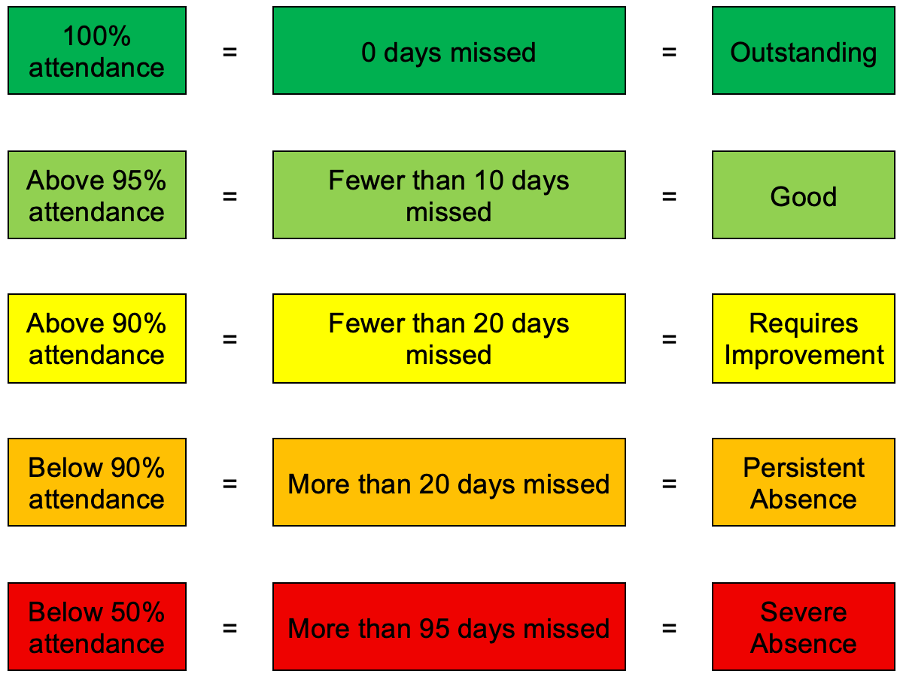
The headteacher sends letters of congratulation to parents and carers of children achieving 100% attendance; attendance of 95% or above, or significant improvement in January and April.
Lateness patterns and unauthorised absences trigger a communication from the headteacher. Failure to improve or non-engagement with the school in offering support can lead to involving the Local Authority Attendance Officer and even legal sanctions.
Granting leaves of absence
Only exceptional circumstances warrant a leave of absence. We consider each application individually taking into account the specific facts, circumstances and relevant background context behind the request.
If a leave of absence is granted, it is for the headteacher to determine the length of time the pupil(s) can be away from school.
As headteachers should only grant leaves of absence in exceptional circumstances, it is unlikely a leave of absence will be granted for the purposes of a family holiday.
You can be fined for taking your child on holiday during term time without the school’s permission.